Foundation crack repair
A crack in concrete is not always a disaster. But some cracks mean movement, water entry, or pressure that needs real attention. BedrockBearing is a **free matching service** that helps you understand the issue and compare licensed, insured repair pros.
What foundation crack repair means
Foundation crack repair is a broad term. It can mean sealing a crack to stop water. It can mean filling a crack to restore some continuity in the concrete. Or it can be one small part of a bigger plan if the foundation is still moving.
The important point: repairing the crack is not the same as fixing the cause. If the real problem is settlement, expansive soil, poor drainage, hydrostatic pressure, or a bowing wall, a simple sealant may not last.
Common crack types homeowners see:
- Hairline shrinkage cracks in poured concrete. These are often cosmetic, but should still be watched.
- Vertical cracks in basement or crawl space walls. Some are minor. Some may let in water.
- Diagonal or stair-step cracks in block, brick, or concrete. These can suggest movement or settlement.
- Horizontal cracks or bowing walls. These are more concerning because they may point to soil pressure and structural movement.
- Slab cracks in floors or garages. Some are normal shrinkage. Others may come with uneven floors or movement.
If you also see sticking doors, sloping floors, widening gaps, water intrusion, or walls moving inward, do not assume a crack filler is enough. Review common warning signs here: foundation warning signs.
How crack repair usually works
The right method depends on the crack material, width, pattern, whether it is active, and whether water is involved. A licensed contractor may use one or more of these methods:
1. Epoxy injection
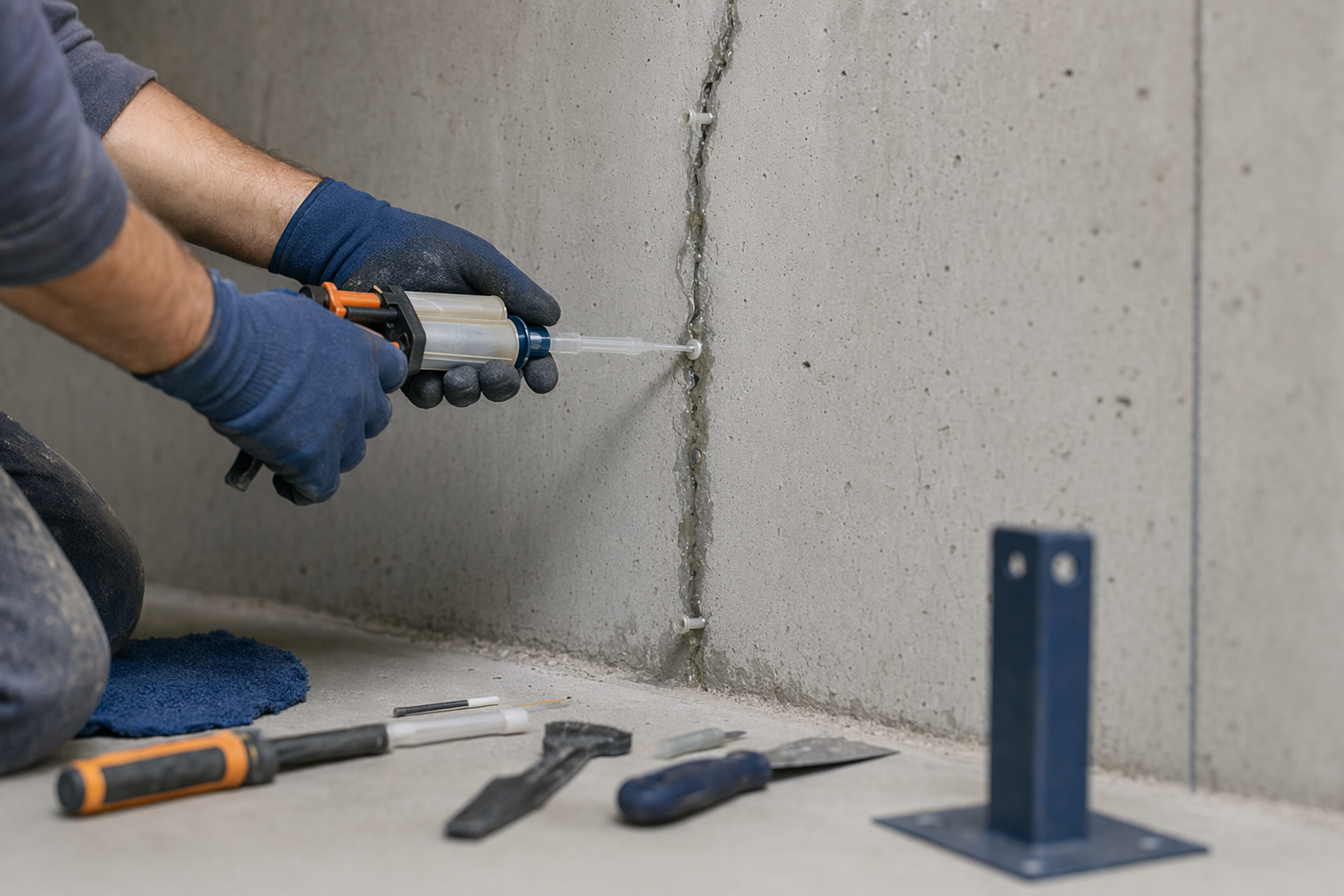
Often used on certain poured-concrete cracks when the goal is to bond the concrete and fill the crack. Typical small-job range: about $300-$2,500.
2. Polyurethane injection
Often used when a crack leaks and the goal is to block water entry. It is flexible and commonly used for wet cracks. Typical small-job range is also often about $300-$2,500, depending on access and crack length.
3. Routing and sealing
More common for some slabs, garages, or non-structural surface cracks. This may improve moisture resistance and appearance, but may not address movement.
4. Stitching, reinforcement, or stabilization
In some situations, a contractor may recommend carbon fiber, steel, or other reinforcement if the wall has movement. If a wall is bowing or under pressure, read more about bowing wall stabilization.
5. Drainage or waterproofing work
If the crack leaks because water pressure is the real issue, drainage improvements may matter more than the crack seal itself. Related work can range about $2,000-$12,000 for basement waterproofing or drainage depending on scope.
6. Underpinning or piers
If cracks are from settlement, a contractor may recommend piers. Typical US ranges are about $1,200-$3,000 per pier, and many jobs need 8-12 piers, so larger jobs can reach $10,000-$30,000+. Learn more about piering and underpinning.
Engineer first matters here. Before you hire a repair company, strongly consider an evaluation by an independent, licensed structural engineer who does not also sell the repair. That helps you separate the crack symptom from the real cause. A typical engineer report often costs about $400-$1,200. See why that step matters.
What crack repair costs in the real world
Honest pricing starts with this: there is no single crack-repair price. The real cost depends on:
- the cause of the crack
- the soil and site conditions
- whether the crack is active or old
- the wall type: poured concrete, block, brick, or slab
- water problems and drainage conditions
- access to the area
- the repair method required
- your local labor and permit environment
Typical US ranges:
- Crack injection: roughly $300-$2,500
- Slabjacking/mudjacking or foam for a typical area: roughly $600-$3,500
- Steel push or helical piers: roughly $1,200-$3,000 per pier, often $10,000-$30,000+ total on larger jobs
- Bowing-wall stabilization with carbon fiber or beams: roughly $4,000-$15,000+
- Basement waterproofing/drainage: roughly $2,000-$12,000
- Independent structural engineer report: often $400-$1,200
Those are typical ranges and estimates, not quotes or guarantees.
A common mistake is comparing a low injection price to a higher stabilization price as if they solve the same problem. They often do not. One may seal a leak. The other may address movement. If you want a broader cost overview, see foundation repair costs or our page on foundation crack repair.
How long it takes and what to expect
Small crack-sealing work may take only a few hours. More involved work can take days. If engineering, permits, excavation, drainage, or underpinning are needed, the full process can take longer.
A typical path looks like this:
1. Document what you see
Take clear photos. Note the crack location, length, width, whether it leaks, and whether doors or floors changed nearby.
2. Get an independent engineer evaluation first
Especially if cracks are growing, diagonal, horizontal, repeated, or paired with movement.
3. Use the engineer's findings to compare repair options
Then talk with licensed, insured contractors. BedrockBearing can help you get matched for free.
4. Review the written scope carefully
It should say what method will be used, what problem it is intended to address, whether permits are needed, cleanup terms, and warranty terms if offered.
5. Repair day
For injections, the contractor may clean the area, install ports, inject material, and remove surface hardware later. For stabilization or piers, expect more noise, tools, and in some cases excavation.
6. Monitor afterward
Even after repair, keep an eye on crack width, water entry, floor level changes, and sticking doors. A repaired crack that reopens can mean the underlying movement is not solved.
If a wall is actively moving, a large new crack is opening quickly, or there are signs of imminent collapse, leave the area and contact a licensed structural engineer or your local building department right away.
When crack repair makes sense, and when it does not
Crack repair may make sense when:
- the crack is minor and stable
- the main issue is water entry through an otherwise stable wall
- an engineer or qualified contractor confirms there is no larger settlement or lateral-pressure problem
- the repair is part of a broader plan that also addresses drainage or movement
Crack repair may not be enough when:
- the crack keeps growing
- the wall is bowing, tilting, or bulging
- there are multiple stair-step or diagonal cracks
- floors slope or doors suddenly stick
- windows go out of square
- you see separation at trim, ceilings, porches, or attached garages
- water pressure outside the wall is still not addressed
Pros of targeted crack repair:
- lower cost than major structural work in the right situation
- often fast
- can reduce leaks and moisture entry
- may improve appearance
Limits and risks:
- it may treat the symptom, not the cause
- some repairs are not a good fit for active movement
- a low price now can become a higher price later if the real problem continues
That is why we keep coming back to the same advice: start with an independent, licensed structural engineer before hiring a repair seller.
Questions to ask before you sign anything
Use these questions with any contractor you are considering:
- Are you licensed and insured for this work in my area? Can you send proof so I can verify it myself?
- What do you believe is causing this crack?
- Is your plan meant to seal water, restore concrete continuity, stabilize movement, or some combination?
- Do you recommend I get an independent structural engineer report before work starts?
- What happens if the crack reopens or if water still enters?
- Will this work require a permit? Who handles it?
- What exactly is included in the written scope and total price?
- What preparation, access, dust, or cleanup should I expect?
- Are there drainage or grading issues outside that also need to be corrected?
- What payment schedule do you require, and what must be complete before final payment?
Protect yourself:
- Verify the contractor's license and insurance yourself
- get the scope and price in writing before any deposit
- follow local permits and building code
- compare more than one opinion when the diagnosis is unclear
For a deeper checklist, read how to vet a foundation contractor.
How BedrockBearing helps
BedrockBearing does not inspect foundations, design repairs, pull permits, or perform the work. We are a free, multilingual matching service for US homeowners, including new immigrants and non-native-English speakers.
We help you:
- explain what you are seeing in plain language
- understand what questions to ask
- connect with licensed, insured foundation repair pros in your area
- compare options without paying us anything
Participating pros pay a flat fee to be listed in our matching system. The service is free to the homeowner.
You stay in control:
- an engineer evaluates
- you compare estimates
- you choose who to hire
- you hold the final payment until the agreed work is done
If you are ready to start, you can get matched at no cost.
A small crack may only need sealing, but a moving or leaking crack can mean a bigger problem. Get an independent licensed structural engineer first, then compare written estimates from licensed and insured contractors, and only pay for work that matches the real cause.